News

The cruise industry is rarely short of sustainability ambition. No cruise line worth its salt is without a weighty document on the subject somewhere on its website, usually paired with a confident press release. The fair question is whether that is mostly words or whether there are real plans behind it.
Here is where things stand on sustainable cruising and responsible travel going into 2026, and how to tell actual progress from the rest.
Plenty is happening on both cleaner fuels and energy efficiency. Ships built to run on LNG (liquefied natural gas) are increasingly the default for new ocean vessels rather than the exception. Air lubrication systems, which pass a carpet of bubbles under the hull to cut friction, are reducing energy losses, and fuel cell technology is close to being ready for use at sea.
What is actually changing
Cruise lines are often criticised for appearing not to care about their environmental impact. In practice, the opposite is true, if only because a sustainable future is squarely in their own commercial interest. Getting there takes serious investment and close work with some of the best scientists and engineers in the field.
What stands out now is how many parties are pulling in the same direction. Governments are more engaged, industry is investing more, and ports, shipbuilders, power suppliers and maritime bodies are working together to speed up cruise decarbonisation, much of it overseen and supported by the Cruise Lines International Association. The shared target is net zero by 2050.
The technical partners are just as important as the lines themselves. Wärtsilä, whose engines power a large share of the fleet, has committed under its Set for 30 plan to be carbon neutral in its own operations by 2030 and to offer a portfolio ready for zero-carbon fuels by the same date. There is substance behind the pledge: the company had cut its own emissions by around half relative to its baseline by the end of 2024, and has since added a target to reduce its suppliers' emissions as well.
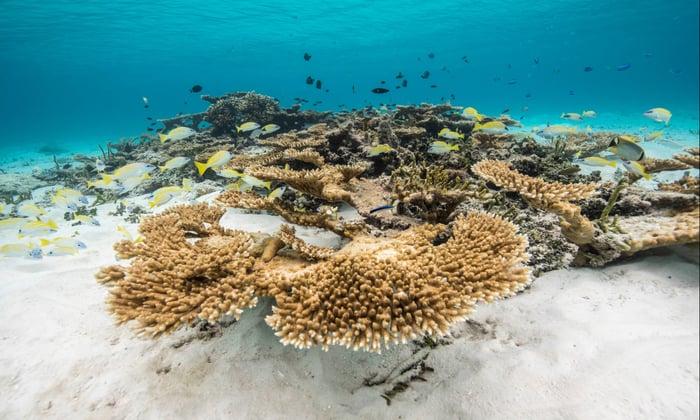
As sustainable travel has moved from a specialist concern to a mainstream one, we have grown more wary of greenwashed announcements, the kind with more polish than substance. The encouraging news is that many of the lines, ports and destinations we work with have put sustainable and in some places regenerative tourism at the centre of how they operate rather than at the edge of it.
Cleaner fuels and the ships pointing the way
Fuel is the hardest part to call. The technology is moving so quickly that even the lines cannot be certain which way it will settle, so their engineers design ships flexible enough to take whichever fuel proves most sustainable. LNG is a reasonable compromise today, especially if carbon capture improves, but the route ahead runs through greener options: hydrogen, ammonia or synthetic LNG. Because some otherwise carbon-neutral fuels still rely heavily on fossil fuels in production, green hydrogen looks like the frontrunner.
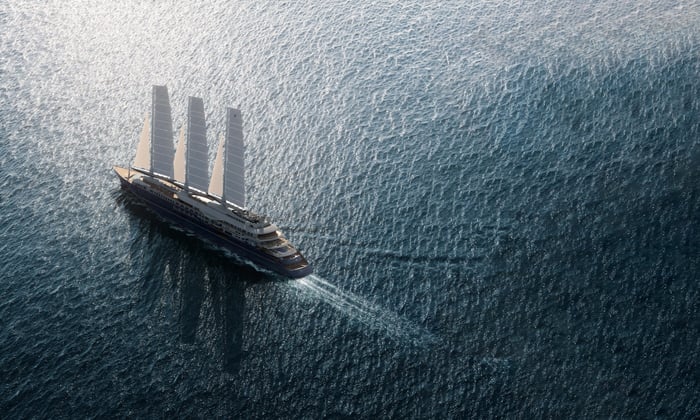
You can see that thinking in the ships now on the water and on the drawing board. The Orient Express Corinthian, entering service this year as the world's largest sailing yacht, carries just 110 guests in 54 suites and uses three rigid SolidSails alongside an LNG motor, with a hydrogen-ready design. On the eve of its debut, its builder, Chantiers de l'Atlantique, presented an even larger sailing concept called Marin@Seas: a 260-metre ship for 650 guests with four SolidSail rigs, capable of running with zero emissions under sail alone.
Others are looking past combustion altogether. The German yard Meyer Werft has set out a concept it calls Vision, which would be the first fully battery-electric cruise ship of its size, more than 80,000 gross tons and carrying 1,856 guests, with a battery system from Corvus Energy and up to a 95% cut in greenhouse emissions. It is designed for shorter European routes as charging ashore becomes more common, and could be delivered around 2031 if a line places an order. Closer to our own world, the expedition operator Oceanwide Expeditions has signed a letter of intent for two small hybrid sail expedition ships carrying 146 guests each, due in 2029 and 2030.
These are still concepts, though. Marin@Seas and Vision are design studies, and the Oceanwide ships are a letter of intent rather than a confirmed order, so none of them are bookable today. What they show is direction, and the direction is not in doubt.
Expedition and the polar regions, leading from the front
The surge in expedition new builds has put this end of the industry at the front of practical innovation, much of which then spreads across the wider fleet. The polar regions show why.
IAATO, the International Association of Antarctica Tour Operators, was founded in 1991 by seven companies and now represents more than 100 members committed to safe and responsible travel in Antarctica, sharing best practice on marine operations, fuel use and education. Members have unanimously agreed to whale protection measures, including reduced speeds in certain waters, and they directly support science by carrying researchers and their equipment. That hands-on field experience makes them frequent early adopters of new environmental practices.
In the Arctic, the pressing question is the effect of tourism on small communities. The Association of Arctic Expedition Cruise Operators exists to ensure Arctic expedition travel occurs in partnership and dialogue with local people, so that a cruise call genuinely benefits the communities it reaches, with residents involved from the start.

The view from shore: power, ports and overtourism
Fuel is only part of the picture. One of the most effective things a ship can do is switch its engines off in port and plug into the local grid, which can cut its emissions while docked by up to 98%. The fleet is increasingly ready for it: more than half of the Cruise Lines International Association's member ships can now connect to shore power, a figure that has more than doubled since 2018, and close to 240 ships are expected to be capable by 2028.
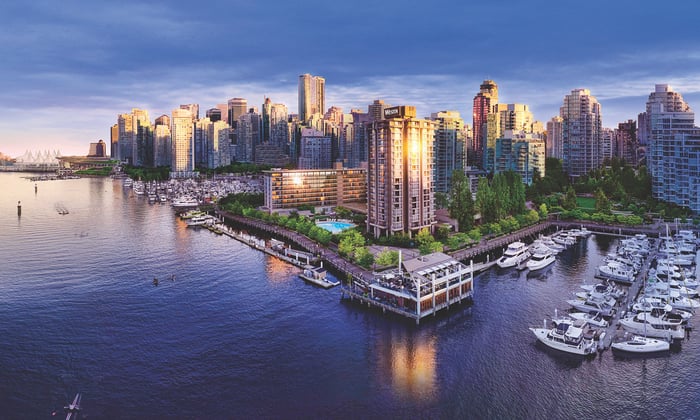
The bottleneck sits on land. Fewer than 3% of the world's cruise ports, around 35 in total, currently offer shore power at all. Some are well ahead. The Port of Vancouver brought shore power to its Canada Place terminal back in 2009, the first cruise terminal in Canada to do so, running on almost entirely hydroelectric power, and is now expanding it as part of a Pacific Northwest-to-Alaska green shipping corridor. The honest counterpoint sits closer to home. Southampton installed shore power for cruise ships in 2021, yet ships have plugged in only a handful of times since, with the UK's high electricity costs widely blamed. The capability is there; using it has to make economic sense first.
Ports are also where the overtourism argument tends to land, and cruise is an easy target for it. What often gets lost is the value a call brings. Southampton, which handles around 85% of the UK cruise market, welcomed roughly three million passengers in 2024 and contributed over £1 billion to the local and regional economy, with a single turnaround of a large ship worth up to £2.5 million in local spending and supply. Handled well, cruise works in partnership with a destination rather than against it, bringing investment and jobs alongside the visitors.
What this means if you are choosing a cruise
For a traveller who cares about this, the useful thing is to separate what is real now from what is still ambition. The progress is already visible in smaller ships that tread more lightly, lines that plug in where they can, ports investing in clean power and itineraries that move at a gentler pace. The concepts, the battery and sail ships, point to where the next decade is heading and are well worth watching, though they are not yet choices you can make.
Responsible travel at sea comes down to choosing operators whose commitments hold up to scrutiny, and destinations that gain from your visit. That is what sustainable travel looks like in practice, and it is the part we are glad to help with: honest guidance on what sustainable cruising actually means for the kind of holiday you have in mind. If that would be useful, do talk to us.

Meet the Author